
Realm of Weaponization
Cognitive Warfare & Pre-Criminality


[Video: Professor James Giodano on the “Battlescape Brain” discussing nanoparticles and nanomaterials.]
There is a moment in every empire when the battlefield moves inward. Not toward cities, but into minds. Not toward borders, but into perception itself.
What emerges in this technocratic realm is not conjecture—it is a doctrinal shift already underway, in Europe, in Asia, and long down the road in the United States.
Cognitive Warfare marks the point at which human consciousness is no longer treated as an emergent phenomenon to be understood, but as a domain to be mapped, predicted, and pre-empted.
This is the militarized frontier of the 21st century.
From Territory to Thought
Building upon research streams seeded by DARPA, IARPA, and NATO-aligned doctrine, the modern battlespace has expanded beyond land, sea, air, space, and cyberspace. It now includes cognition itself—the neurological and emotional substrates that precede belief, intention, and action.
In this framework, neural signatures are not medical artifacts. They are signals. Patterns of attention, emotional volatility, stress responses, and ideological deviation become measurable phenomena. What once required interrogation, electric shock, torture, waterboarding at black sites infiltration, and informants can now be inferred probabilistically, long before a word is spoken or an act is committed.
The objective is no longer to respond to dissent. It is to pre-empt it.

The Rise of Pre-Criminality
Cognitive Warfare collapses the traditional distinction between thought and action. Pre-criminality does not ask what you have done, but what you might do under sufficient pressure, past history, or AI computer error.
It relies on predictive psychometrics: AI systems trained to identify emotional tipping points, neural vulnerabilities, profiled tendencies, and behavioral trajectories across populations.
In this model:
Dissent is not illegal; it is diagnostic.
Resistance is not punished; it is pathologized.
Belief is not debated; it is corrected.
EEG-derived indicators, biometric stress markers, and behavioral data streams converge to form risk profiles that exist entirely upstream of crime. Intervention becomes administrative rather than judicial. Surveillance becomes therapeutic in language, even as it remains coercive in effect.
The subject is not accused. The subject is managed. The UK Digital ID system is the data ocean of capturing and “credit scoring” (à la Communist China) its citizens in a 1984 on steroids of mass control. Dissent will be forbidden.
[Video: Teaser for the coming 2026 documentary film, “6G Biohack: The Anti-Human Agenda.” Written by James Grundvig. Edited by D.C. Krieger. Music by DaVinci. The film will be directed by Alexandra Bruce of Forbidden News.]
Cities as Cognitive Battlegrounds
In the civilian domain, the implications are profound. Smart cities—already saturated with sensors, cameras, wearables, and behavioral telemetry—become cognitive terrains. AI systems are tasked not merely with traffic flow or energy optimization, but with detecting what might be called ideological dysrhythmias: Deviations from statistical norms of belief, affect, or compliance.
Neural deviation does not trigger arrest. It triggers attention. It makes the potential offender “interesting” enough to track, trace, model, and do deeper research across all government and corporate databases.
Your information does not belong to you anymore.
Monitoring intensifies. Access narrows. Friction appears—subtle, deniable, bureaucratic. The individual is not told they are under scrutiny. They are simply slowed, flagged, or nudged back toward acceptable cognitive ranges.
This is not the blunt trauma of MK-Ultra. It is its evolutionary successor.
Near-future Cognitive Cities represent the quiet fulfillment of George Orwell’s warning—not through jackboots in the streets, but through systems that make the streets unnecessary. In 1984, power is enforced by omnipresent surveillance and the terror of visible punishment. In the Cognitive City, surveillance is ambient, affectionate, and data-driven. Cameras, sensors, wearables, and AI do not merely watch; they anticipate. Thoughtcrime no longer requires confession because intention is inferred upstream, modeled through behavior, biometrics, and emotional telemetry. The boot is still present—but it is no longer worn. It is embedded into infrastructure, policy, and code.

Section 39’s Jackboot Paradox reveals the deeper evolution: control no longer needs to crush the human spirit if it can reshape the conditions under which choice is made. Orwell’s jackboot on the human face forever becomes a statistical inevitability rather than a physical act. Citizens in Cognitive Cities will not be terrorized into obedience; they will ve calibrated into compliance.
Language is softened, enforcement is bureaucratized, and dissent is reframed as instability or risk. The tragedy is not that freedom is taken. But that it is forgotten… Until one day resistance feels not heroic, but irrational.
The future Orwell feared arrives not with violence, but with consent engineered so thoroughly that the jackboot is never seen—only felt, as pressure, everywhere, all at once.

[Downloadable Deck. “War for the Mind: Battle of Light and Darkness Control for the Human Mind,” created by James Grundvig, shows how far the global Cabal has come to achieving mass mind control.]
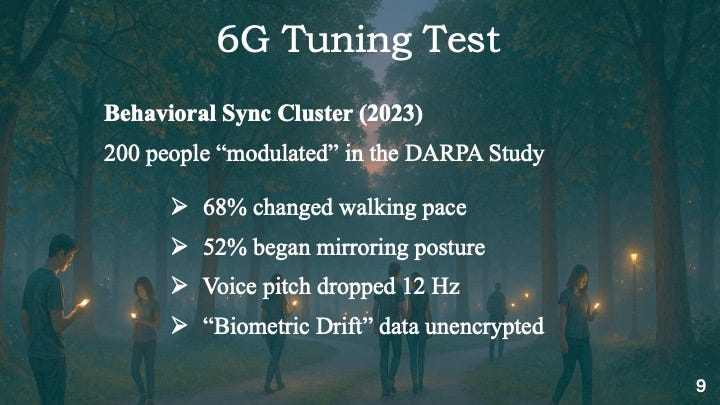
MK-Ultra Updated for the Digital Age
Where MK-Ultra relied on shock, drugs, and dissociation, its modern descendant relies on data, the ocean that is continuous, ambient, and invisible. Trauma is no longer induced; it is predicted. Control is no longer forced; it is optimized.
The collapse of autonomy will be permanent, if Europe’s Hexa-X (sponsored by China and the United States, along with 21 other stakeholders including major telecoms and the WEF) gets its way with a roll out of 6G mass mind control frequencies on the global cell towers network.
The central threat posed by Cognitive Warfare is not surveillance. It is the erosion of agency itself.
When autonomy is assessed probabilistically, free will becomes a liability rather than a right. When belief is framed as a risk vector, cognitive liberty becomes incompatible with security doctrine. The individual no longer stands as a sovereign moral actor, but as a node within a population model.
Mental sovereignty—once assumed, rarely articulated—emerges as a geopolitical resource.
Nations that can map, influence, and stabilize cognition gain strategic advantage without firing a single shot. Societies that cannot protect the interior freedom of thought find themselves governed not by consent, but by calibration.
If you don’t think the rollout of the Covid-19 psyop and graphene oxide-laden Covid vaccines (bioweapons) didn’t play a role in creating the opportunity for the technocrats to achieve a global hive mind of the masses, you better check your receipts.
The Flashpoint Ahead
Cognitive liberty is the coming fault line. As predictive systems mature, the temptation to intervene earlier—to correct sooner, to nudge harder, to silence quietly—will prove irresistible to power hungry globalists.
The language will remain benevolent. Safety, resilience, wellness, stability. But beneath the serpent’s tongue lies a simple inversion: The mind is no longer the final refuge of freedom. It is the next terrain of control.
Tomorrow: Section 42.